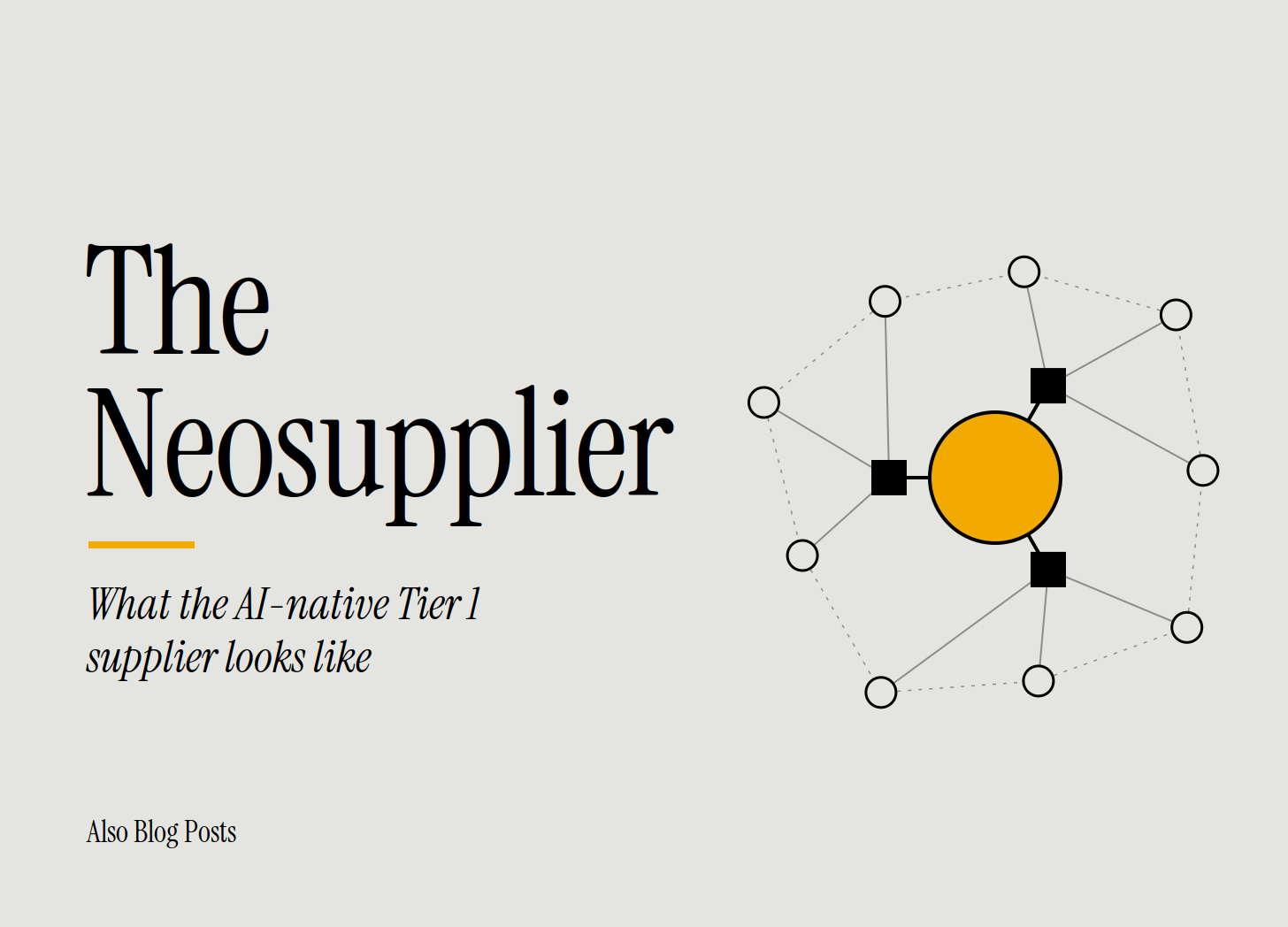
We’ve long held the view that the venture market has overrotated on the vertical integration narrative. Instead, we think there’s an emerging opportunity in what we call Neosuppliers.
Neosuppliers leverage the latest technology to improve customer experience and product margins, and earn higher customer LTV as a result. They can scale fast, often getting to 9-figure revenue in just a few years if executed and capitalized well.
A Neosupplier is a supplier first and a software company second. It wins OEM programs because it’s faster, more reliable, and easier to work with than a legacy Tier 1, and AI is the reason it can be.
Neosuppliers that are viable as venture investments share a few core characteristics:
Speed as the product. AI-driven quoting, DFM feedback, and process planning compress weeks into hours. An OEM gets a quote, a manufacturability critique, and first articles faster than a legacy shop can return an email.
Engineering partner, not build-to-print. It co-designs subsystems with the OEM and owns integrated assemblies. That’s what makes it a true Tier 1 rather than a job shop.
Selective vertical integration. It owns the bottleneck processes where quality, IP, or lead time is decided, and orchestrates a vetted network for everything else. Its edge comes from knowing which is which.
High-mix, fast-ramp economics. Flexible automation and low changeover costs let it make money at prototype volumes and scale to rate production without requalifying.
Data as the moat. Every part generates process and quality data, which feeds a closed loop that improves yield, pricing accuracy, and lead times. Traceability and compliance (AS9100, ITAR, CMMC) are built in from day one.
Labor leverage. It needs fewer, more skilled people per dollar of revenue, often multiples of a legacy supplier’s revenue per employee.
Better margins than the category. It structurally beats the thin margins of contract manufacturing, through pricing power on speed and lower cost to serve.
Domestic and allied by design. It’s positioned for reshoring and defense demand, where resilience is worth a premium.
Importantly, if it doesn’t take ownership of the part and the outcome, it’s not a Neosupplier. Marketplaces that broker other shops’ capacity, or a SaaS tool sold to factories are not Neosuppliers.
A simple diligence test: would an OEM sole-source a critical subsystem to this company, and is that decision getting easier with each program it delivers? If yes, that’s an interesting opportunity!