


Lasting moats are built by solving hard problems while the outcome is still uncertain. Uncertainty isn’t the moat, but it keeps everyone else out long enough for you to build one.
Defense tech is a good example. Shape a regulation, get language into the NDAA, land a mandate, and demand becomes certain overnight. The revenue is real and sometimes fast, but the benefits rarely accrue to you alone. A ban on Chinese drones lifts every American drone maker at once. A new acquisition pathway is open to anyone who can fill out the paperwork. And rules change: the next administration, appropriations fight or program office reorg can take it all back. If your only edge is a rule in Washington, you don’t own your moat. You’re renting it.
Here’s how we think about the trade-offs:
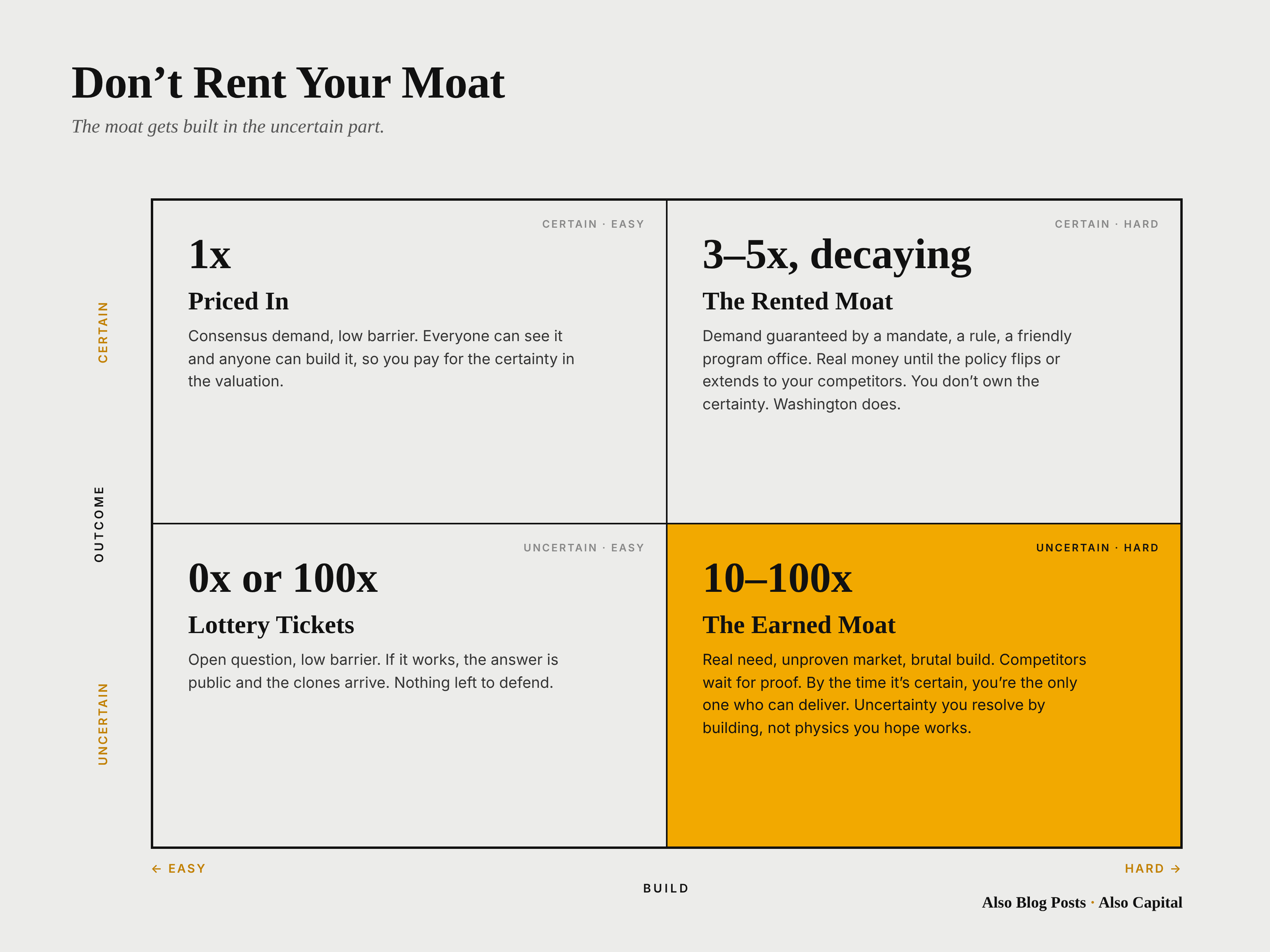
We focus on the bottom right: an unproven market and a brutal build. Here uncertainty works in your favor. By the time the market agrees the thing is real, you’ve spent three years learning how to make it, sell it and support it. When certainty finally shows up, you’re the only one who can deliver. A moat built that way is very hard to take back (Falcon 9, anyone?).
Uncertainty alone isn’t a strategy, though. The bottom left is uncertain too. If an easy bet works, the answer is public and the clones show up the next week. You need uncertainty and difficulty together.
And pick uncertainty you can resolve. Adoption, cost curves and manufacturing at scale are questions that building answers. Physics that may not work, or the next election, are things you just wait out. Bet on the first kind.
Take the regulatory tailwind when it comes, because it can be a great catalyst. Just don’t build the company on it. Rent the tailwind and earn the moat.